

When the past met the future of music in Kalamata – Review on monopoli.gr
Aristoula Zachariou | Originally published on monopoli.gr, September 6, 2025.
We travelled to Kalamata to experience the 9th International Kalamata Music Days, an event that transforms the Messenian capital into a vibrant centre of artistic creation and exchange — a festival where the past conversed with the present and the future of music.

The artistic directors of the International Kalamata Music Days Stathis Giftakis, Indira Rahmatulla, Dimitrios Lampos ǀ Photo: Stylianos Papardelas
When one thinks of Kalamata, the mind does not linger solely on its image as a seaside city with a rich history — the first to be liberated during the Greek War of Independence (23 March 1821) — nor merely on its authentic Mediterranean allure. It also evokes a city that consistently fosters a dynamic and multifaceted cultural life. This becomes evident in the way Kalamata embraces the arts, both through its institutions and festivals and through the warm, genuine response of its people.
Among these festivals — now firmly established — is the International Kalamata Music Days festival, under the artistic direction of cellist Indira Rahmatulla, composer Stathis Giftakis and cellist Dimitrios Lampos. Each year, the festival transforms the city into a meeting ground for artists from Greece and abroad, a pulsating hub of high-level concerts, international collaborations and educational initiatives.

Snapshot from the final concert of the cello masterclass ǀ Photo: Stylianos Papardelas
This year, I visited Kalamata from 29 to 31 August and was able to experience the 9th edition of the festival, which concludes this Saturday, 6 September. It was not my first encounter with the festival — my first visit had taken place in the summer of 2023. Two years later, carrying with me positive impressions and cherished memories, I returned, and I can say with certainty that the festival lived up to those expectations.
Music as a “common ground”
In its ninth edition, the International Kalamata Music Days remained loyal to two core beliefs. The first is that no musical genre is inaccessible to the public, regardless of how familiar one may be with it. This is felt in the way every attendee, even without the slightest acquaintance with classical music or jazz, can feel welcome at the events and freely surrender to the magic and emotional uplift that music so generously offers.
The second belief formed the very backbone of this year’s programme. At a time when, across the globe, the things that divide us manifest as violent conflicts, humanitarian crises and extreme situations, the festival sought, as artistic co-director Dimitrios Lampos explained in an interview two weeks prior, the “common ground” that leads us to make music — “the timeless experience of being human”.
How did this concept take shape within the programme? First, through the revitalising coexistence of diverse traditions and genres, from the Middle Ages to contemporary artistic expression. And secondly, through the “heart” of the festival — its educational programmes.
A new generation of talent
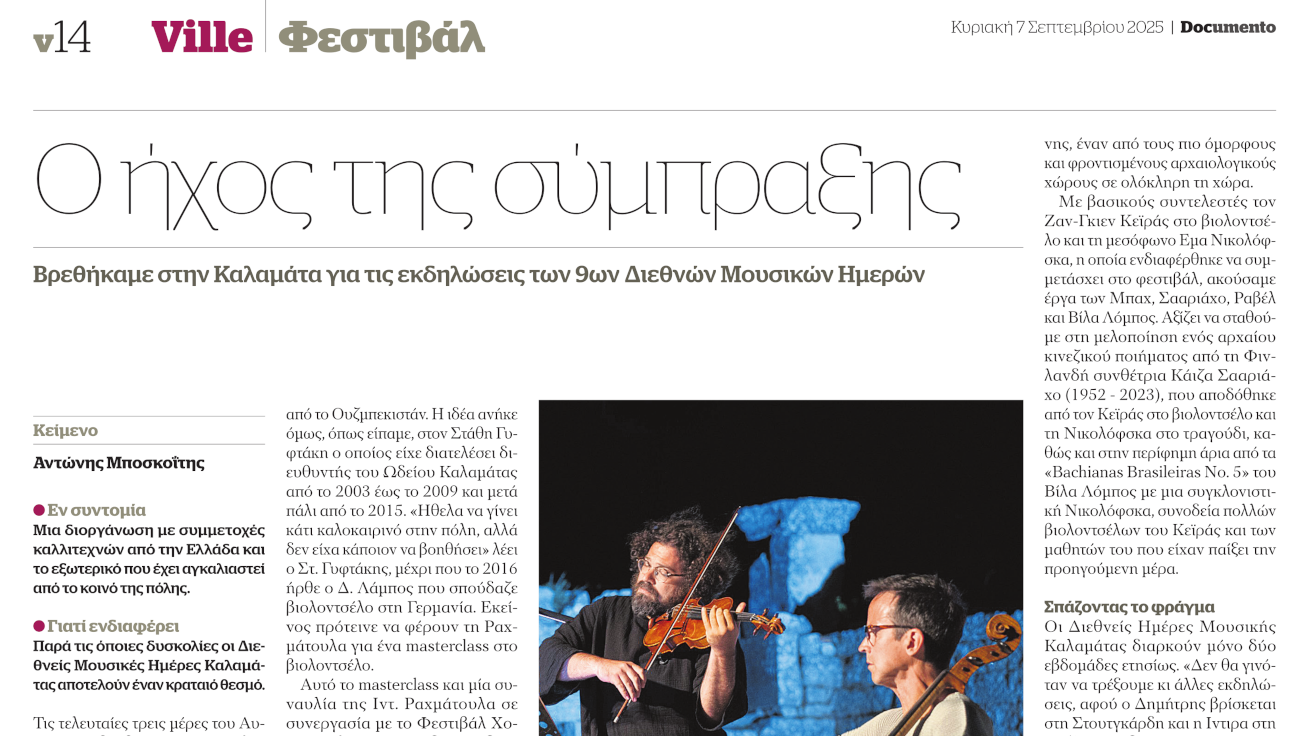
Five masterclasses were held during the 9th International Kalamata Music Days, all led by internationally acclaimed musicians from Greece and abroad. On my first day in the city, I attended the final concert of the cello masterclass with Jean-Guihen Queyras, presented at the Alternative Stage of the Kalamata Dance Megaron.
The six young performers who took to the stage — selected from 42 online applications from across the world, all of such high calibre that six rather than the usual five were accepted — presented a varied and rich programme. This “pantheon” of different eras and aesthetic movements ranged from Beethoven, Mendelssohn and Rossini (classicism–romanticism), to Prokofiev and Hindemith (20th century), to contemporary works including that of Armenian composer Martin Ulikhanyan.
We became witnesses to the fruitful results of the festival’s commitment to sharing knowledge and supporting emerging talent, as well as to the unifying power of music, which draws people together through its universality — irrespective of language, faith or place of origin.
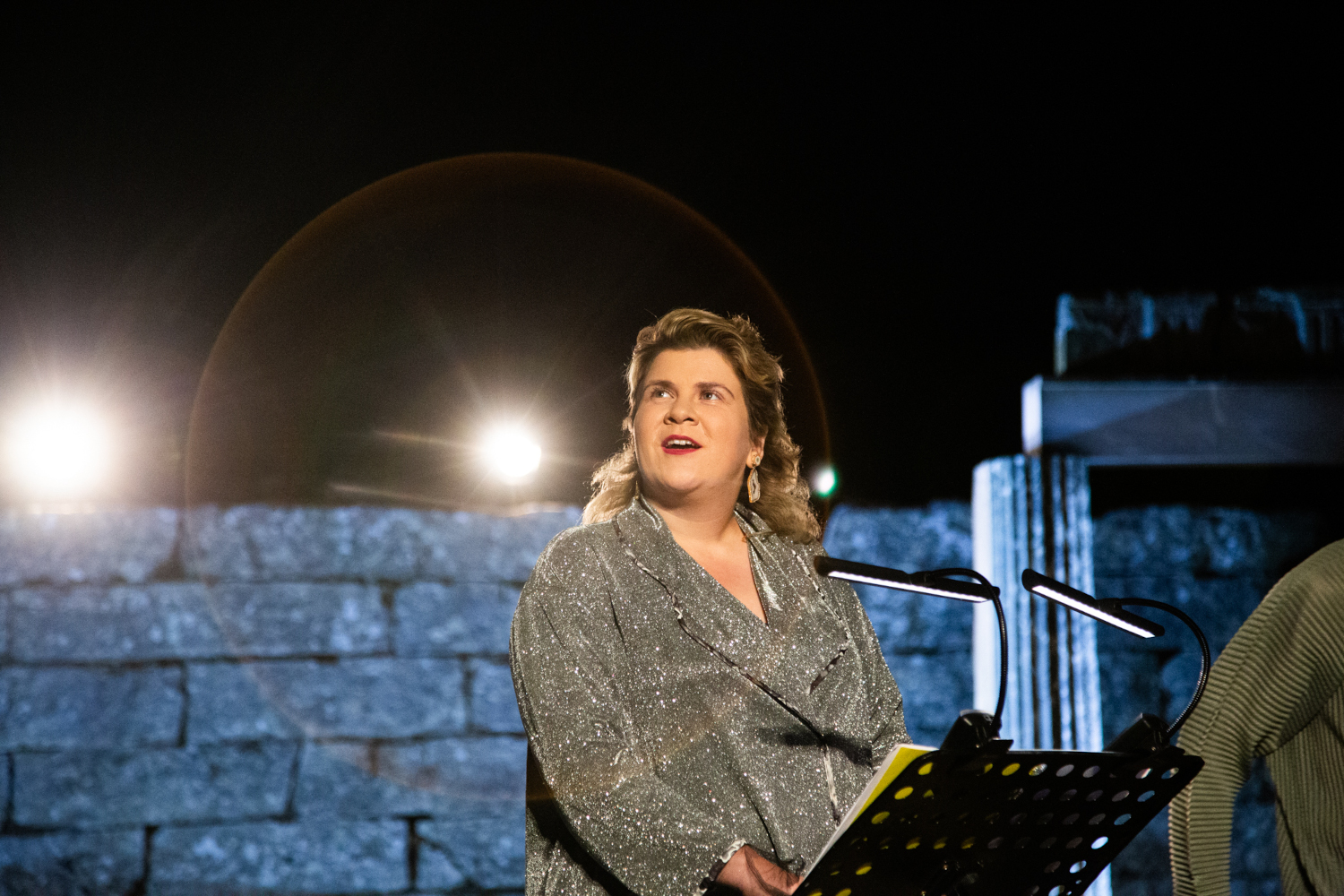
Mezzo-soprano Ema Nikolovska at the Ecclesiasterion of Ancient Messene ǀ Photo: Stylianos Papardelas
The “sacred” atmosphere of Ancient Messene
Each year — except in unforeseen circumstances — the festival prompts an excursion to Ancient Messene, accompanied by live music. It is one of the most anticipated highlights of the programme. And so, on our second day, we found ourselves at the Ecclesiasterion of Ancient Messene for a concert featuring cellist Jean-Guihen Queyras, violinist Jonian Ilias Kadesha, mezzo-soprano Ema Nikolovska and the participants of the cello masterclass — a performance that unfolded as a deeply spiritual experience.
It was not only the atmosphere and mystique of the site — especially as night fell and the moon rose — but also the way historical memory resonated in the present, offering a promise for the future. This was expressed through an intercultural programme that bridged European Baroque with French Impressionism, contemporary Scandinavian music and Latin American influences, and even more poignantly through the shared stage of world-renowned artists such as Queyras, Kadesha and Nikolovska with the “new blood” of musicians taking their first steps in the field.
Thus, at the end of the concert — with the moon overhead, the “sacred” aura of the space and the almost ethereal lyricism of Heitor Villa-Lobos’ “Aria – Cantilena” — one left Ancient Messene with a deep sense of emotion.

Emil Kuyumcuyan and Hugo Rannou invited us to a contemporary ball Evening ǀ Photo: Stylianos Papardelas
Experimentation and renewal
The final day of my stay brought me once again to the Alternative Stage of the Kalamata Dance Megaron for one of the boldest propositions of this year’s festival: a contemporary ball for cello and percussion with French cellist Hugo Rannou and internationally renowned percussionist, composer and electronic musician Emil Kuyumcuyan.
It was one of those evenings when the festival veered well away from the “beaten path”, taking a risk on something more experimental — and judging by the audience’s enthusiastic applause, it was a risk that paid off. The two musicians, bound by what appeared to be a deep friendship, offered an original, humorous and distinctly personal performance that balanced between music and performance art, incorporating improvisation, original compositions, arrangements and unexpected musical “pairings”: Bach, Bastien David, Philippe Katerine, Jacques Brel, Udo Jürgens and Édith Piaf.
If nothing else, that Sunday evening was clear proof that the International Kalamata Music Days remain open to experimentation and continually seek fresh artistic ideas — a feeling that grows stronger year after year. Above all, however, the festival is open to the residents and visitors of the city, to people of all ages and backgrounds, to musicians from every corner of the world who answer its call, and to all those who contribute to its creation. And for anyone seeking a reason to visit the capital of Messenia, the International Kalamata Music Days offer the perfect opportunity.