


MORE INFORMATION:
[A] picture that is in the end difficult to explain in words…. It is a film that clearly embodies the epithet “rhythm of light”; an impressionistic work that has won victory over reason and human feeling. A work that apparently has no need for standards of value like “enjoyable” or “serious” that tries to represent cinema itself.
(1926, as cited in Gerow, 2017)1
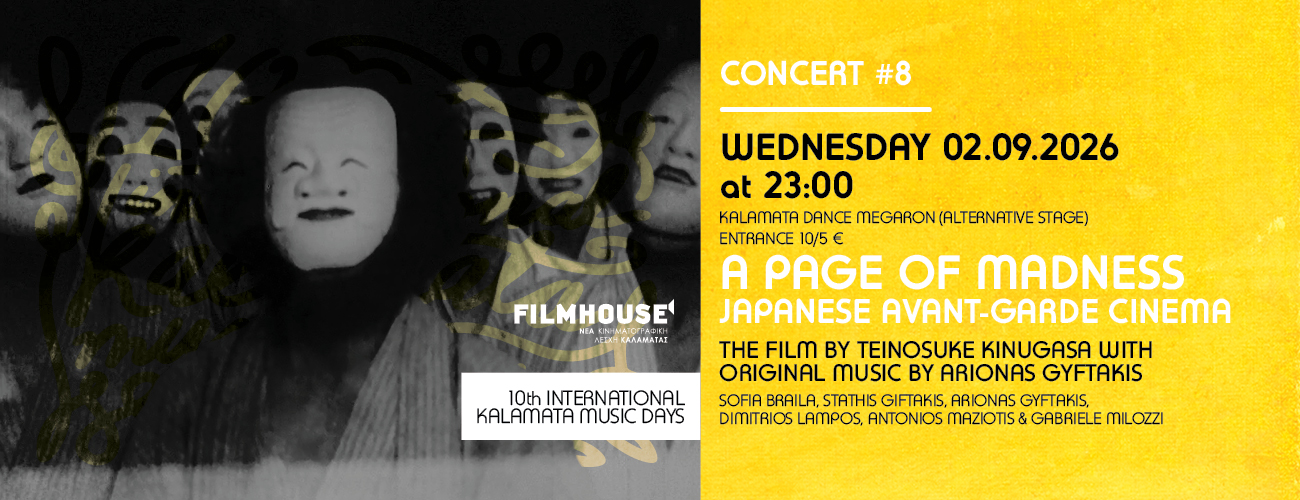
The Japanese silent film A Page of Madness (1926), directed by Teinosuke Kinugasa, made a profound impact upon its release, sparking vigorous debate about the very notion of cinematic “meaning”, the nature of film form itself, and the place of cinema within the society of its time. A century later, it continues to be regarded as one of the foremost masterpieces of experimental and avant-garde cinema. The film emerged from the artistic and theoretical explorations of the Shinkankakuha, literally the “School of New Perceptions”, a literary movement within Japanese modernism that sought to renew artistic experience through a radically new sensory apprehension of reality.
Lost for forty-five years and re-edited by Kinugasa himself during the 1970s, the film’s original form remains unknown. We can say with confidence, however, that its “plot” would have been far more intelligible to audiences a century ago than it is today. Although A Page of Madness never featured intertitles, its screenings were accompanied by professional narrators, known as benshi, who recounted and interpreted the story for the audience.
Engaging in an artistic dialogue from the perspective of the present day with this “mad page” in the history of world cinema, Arionas Gyftakis and the International Kalamata Music Days present Teinosuke Kinugasa’s A Page of Madness with a newly commissioned original score.
1 A. Gerow (2017): “A Page of Madness”, Understanding a Work in its Time, essay accompanying the Blu-Ray release of A Page of Madness by Flicker Alley.
A Page of Madness (Japan, 1926)
Directed by Teinosuke Kinugasa
Written by Yasunari Kawabata, Teinosuke Kinugasa, Minoru Inuzuka & Banko Sawada
Produced by Teinosuke Kinugasa
Starring Masao Inoue, Yoshie Nakagawa & Ayako Iijima
Running time 71 minutes
Concept and artistic direction International Kalamata Music Days
Original music & double bass Arionas Gyftakis
Voice Sofia Braila
Saxophone Gabriele Milozzi
Piano Stathis Giftakis
Violin Antonios Maziotis
Violoncello Dimitrios Lampos
The screening is made possible in collaboration with the “FILMHOUSE” Kalamata New Cinema Club.

ARTIST RÉSUMÉS:
Arionas Gyftakis was born in Kalamata. At seven, he started violin lessons at the Municipal Conservatory of Kalamata. He started electric bass lessons with Nikos Tsotras and Harry Charalampous four years later. His great interest in jazz music led him at 14 to start jazz bass with Sylvios Syrros. During these four years, he also studied jazz harmony and improvisation. During the same period, he also studied classical bass with Takis Kappogiannis. In May 2013, he took exams at the Berklee College of Music and won the Full Presidential Scholarship. There he studied with John Lockwood, Dave Santoro, Eddie Gomez and Hal Crook. Currently, he is teaching at Jazzart in Athens. His collaborations include musicians such as George Kontrafouris, Spiros Manesis, Takis Paterelis, Andreas Polyzogopoulos, Daniel Rotem, Anastasis Gouliaris, Davis Whitfield, Gabriele Milozzi and others.
Sofia Braila was born in Athens. She began studying music at a young age, starting with classical piano lessons. She later enrolled at the Musical Praxis Conservatory, where she studied vocals and participated in the conservatory’s jazz ensembles. Since 2020, she has been studying jazz improvisation with Sylvios Syrros and is currently attending the Jazzart Music School. She has collaborated with various musicians and performed at festivals and concert venues across Greece. In addition to her musical pursuits, she holds a degree in Graphic Design from the University of West Attica and works as a freelance designer.
Gabriele Milozzi started playing the saxophone at the age of 11. He graduated from the Conservatory “G. Rossini” of Pesaro (Italy). In 2011, he was awarded a scholarship to Berklee College of Music. In Boston, he studies with artists such as George Garzone, Hal Crook, Bob Gullotti, John Lockwood, Jason Palmer and many others. He graduates summa cum laude with a major in Performance and a minor in Jazz Theory. He later moves to Athens, where he completes his studies under the guidance of Silvios Syrros. He collaborated with Arionas Gyftakis, Spyros Manesis, Anastasis Gouliaris and played in many venues in Greece, Italy and the USA.
Stathis Giftakis is a Greek composer, pianist, and music educator. He studied piano with Dora Bakopoulou, graduating with distinction, and composition with Theodore Antoniou, receiving a diploma with first prize. His works have been performed in Greece and internationally, including in France, Germany, Italy, Canada, Russia, Belgium, the United States, Portugal, Austria, the Netherlands, and Turkey, by leading ensembles and orchestras. His compositions have received awards in international competitions and have been featured in contemporary music workshops and major festivals, including the Hellenic Festival, the International Dance Festival of Kalamata, and the International Music Theatre Festival of Volos. Stathis has served as Artistic Director of the Kalamata Municipal Conservatory (2003–2009 and since 2015) and, since 2017, of the Kalamata International Choir Competition and Festival. He teaches piano and advanced music theory, is a founding member of the Kalamata International Music Days, and lives in Kalamata.
Antonios Maziotis began his violin lessons at the age of seven and continued his studies at the Department of Music Science and Art at the University of Macedonia in Thessaloniki. In 2011, he won the third prize with his string quartet in a chamber music competition organised by the same department. In the same year, he studied as an Erasmus student at the University of Music in Mainz, Germany. In 2014, he continued his studies at the Anton Bruckner University of Music in Linz, Austria, specialising in both violin pedagogy and instrumental teaching in groups. He appears regularly in solo recitals and chamber music concerts in Greece and abroad. Since 2021, he has been a violin tutor at the Music High School and the Municipal Conservatory, both in Kalamata.
Dimitrios Lampos was born in Athens and grew up in Kalamata, Greece. His musical journey began at a young age at the Municipal Conservatory of his hometown, where he first took up the cello. Later, he moved to Germany, where he studied with Hartmut Tröndle at the Leopold-Mozart-Zentrum of the University of Augsburg. He also holds a Cello Diploma with the highest distinction from the Orfeio Conservatory in Athens, having studied under Nikolas Kavakos.
Further refinement came through his work with Hugo Rannou, alongside a specialisation in cello pedagogy at the State University of Music and Performing Arts (HMDK) in Stuttgart, where he is currently based.
Dimitrios is active as both a performer and educator. His musical interests are rooted in chamber and contemporary music. A passionate educator, he teaches the cello at the Musik- und Jugendkunstschule Nürtingen. He also appears regularly on stage as a chamber musician. He is a co-founder and co-organiser of the International Kalamata Music Days.
Tickets can be purchased from Monday, August 24, at the Kalamata Dance Megaron during the following hours:
18:00–20:00
For reservations, please call +30 698 472 8117 during the following hours:
10:00–12:00
Get the festival pass to attend all concerts: €50 and €25 (reduced).
CONCERTS WITH FREE ADMITION:
Admission to concerts with free entry requires a free admission ticket, which must be collected on the day of the concert. Advance reservations are not available. Tickets are numbered and are issued on a first-come, first-served basis, subject to availability.
REDUCED ADMISSION FOR:
Students.
FREE ADMISSION TO ALL CONCERTS:
Participants of the masterclasses, students of the Municipal Conservatory of Kalamata, as well as volunteers of the festival. Unemployed persons with a valid unemployment card. Disabled persons and people over 65 years of age.