

Stathis Giftakis & Dimitrios Lampos: The human existence as an act of culture – Interview for culturenow.gr (English translation)
Published on culturenow.gr on August 21, 2025.
By CHRISTINA MANOLAKAKI
Stathis Giftakis and Dimitrios Lampos in conversation with culturenow.gr about the 9th International Kalamata Music Days.

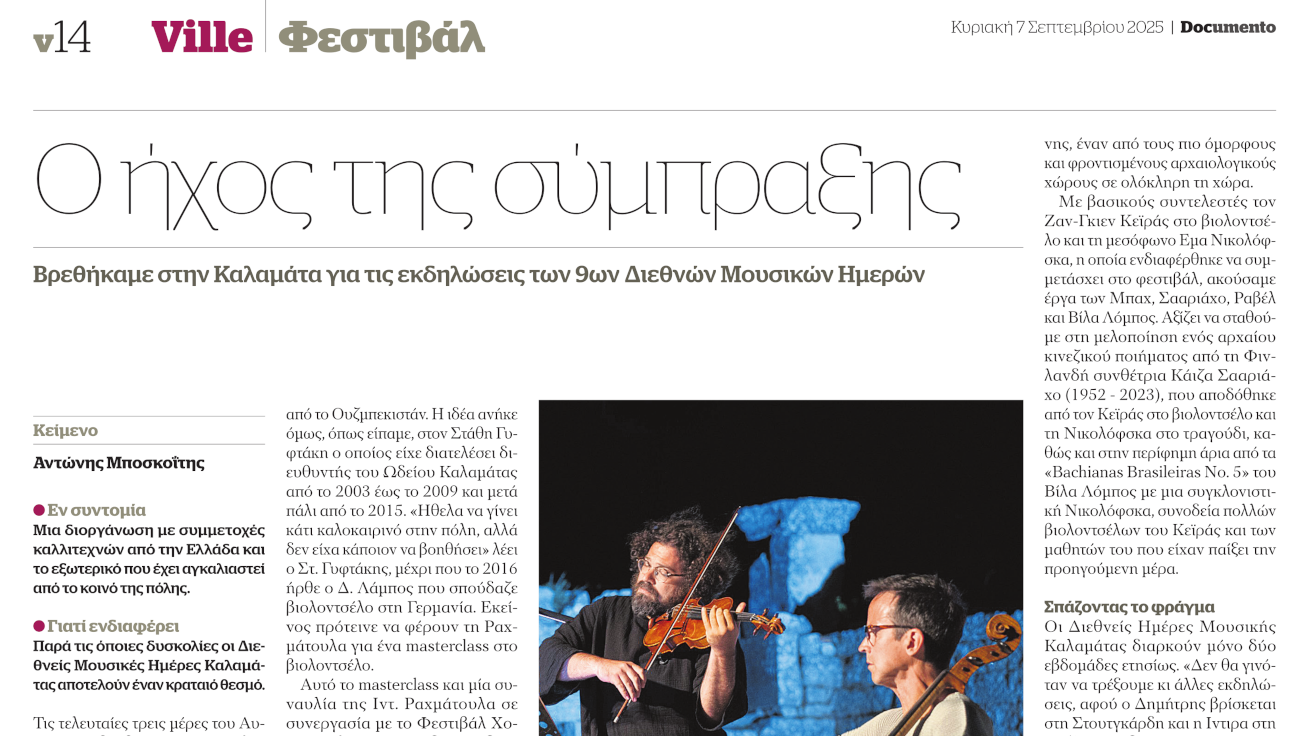
For the ninth consecutive year, Kalamata welcomes the International Kalamata Music Days— an acclaimed festival that has been established as an important cultural event for classical music in Greece and the wider region. From 24 August to 6 September, the city transforms into a vibrant hub of artistic creation, hosting distinguished musicians and soloists from Greece and abroad.
The festival’s Artistic Direction is shared by Indira Rahmatulla, Stathis Giftakis and Dimitrios Lampos. CultureNow spoke with the latter two about this resonant, forward-looking institution, which this year aims to highlight the enduring common ground of human creativity and artistic expression. Amid a world in turmoil, this common ground can only be found in the shared experience of being human —an experience that surpasses any cultural and individual differences.
***
“Is there a specific audience profile you aim for? Does the festival attract new listeners, or mainly those already familiar with classical music?”
Stathis Giftakis: The variety of our programming in a way already indicates the audience we intend to speak to. The festival’s core is the classical music, yet even in concerts focused on this genre we often include others. Today, affinities exist across many musical styles: numerous composers engage with tradition, rock, jazz or even pop in their own way, and many performers construct programmes that bring together works from diverse musical worlds.
This year, the programme weaves together Balkan traditions, avant-garde, jazz, pop, medieval music and, of course, contemporary compositions. Ideologically, we oppose rigid distinctions. Good music is one —aimed at the human soul, spirit and intellect. Fortunately, in previous editions we have succeeded in attracting a diverse audience that trusts us and ultimately gets rewarded for doing so.
“Amid a troubled global climate, the festival speaks of ‘the shared experience of being human’. How is this reflected in the artistic programme?”
Stathis Giftakis: The wars of recent years, the genocide in Gaza, the endless war in Ukraine, the violent clashes across Africa and Latin America —combined with the climate crisis, economic collapse, racism, inequality, social alienation, erosion of social cohesion and the rise of populism and extremism— have pushed societies globally to an impasse. The weakening of state institutions, the questioning of democracy, political polarisation and environmental destruction intensify this deadlock. Those of us who wish to remain human must fight for a rupture with the present and for the establishment of a new social contract.
Art has always played a vital role in such efforts. Music, demonstrably, is a “shared experience”; it moves (“syn-kinesis” in the original Greek text) all people in a similar way. By bringing together many different cultures within the festival, we invite people from every part of the world, of every religion and social background, to meet us and be moved together by the human-centred pulse of music. We become who we are through shared experiences; we are our experiences. Let us celebrate our humanity through our shared musical experience —and may tomorrow be better.
Being human is a cultural event. No one becomes human alone; no one becomes human without the help of others. Each of us becomes part of a collective with which we share beliefs, language, history and tradition —thus forming a sense of “we”.

“International artists enrich the local cultural landscape and place Kalamata on the global musical map. How do you select your guests, and what cultural dialogue do you hope to establish?”
Dimitrios Lampos: The primary criterion for inviting artists —whether Greek or international— is the quality of their musical language. The three of us admire various musicians whom we have encountered through concerts, recordings or collaborations. Often, one of us “discovers” an artist or ensemble, presents it to the team, and in some cases we extend an invitation for them to appear at the festival. There are, of course, many exceptional colleagues, yet artistic quality does not always correlate with commercial success. This is where our new Young Artists Competition comes in —giving younger musicians the chance to present themselves artistically. In terms of artistic planning, variety is also essential. Our foundation is Western art music, but we have always enjoyed engaging in dialogue with other genres and listening to other musical traditions. Within classical music, we consider it important to present new trends and experiments that rarely reach Kalamata, while also honouring historically informed —and at times deliberately “different”— interpretations of earlier repertoire.
As for the exchange of ideas, because we aim for genuine cultural dialogue —in the fullest sense— we seek balance among participants. We do not merely invite prominent international names to perform; that would not constitute dialogue. By giving Greek musicians opportunities to perform and, crucially, to collaborate on stage with colleagues from abroad, we create the conditions for true exchange and open channels between Greece and the international music world —with Kalamata at the centre.
“Tell us more about the dialogue between traditional and contemporary music.”
Dimitrios Lampos: Every new interpretation of a musical tradition begins in the present. Under the weight of the accumulated past, it may unconsciously reproduce long-established habits. On the other hand, it could be informed by historical understanding or it may be following a conscious desire to enrich or renew the tradition with newer —more contemporary— ideas. Last year, we counterposed Greek traditional and Ottoman music with works by Henry Purcell (1659–1695) —who, incidentally, predates Petros Peloponnesios (1730–1777)— as well as Fauré (1845–1924) and Tailleferre (1892–1983). This year, Greek traditional music appears in two concerts. First, the Greek medieval and Renaissance music ensemble Lycabettus will attempt to reconstruct the musical imprint of the cultures that passed through the “Castles of the Morea” during the 12th to 14th centuries, placing Greek traditional music alongside works by troubadours and trouvères such as Raimbaut de Vaqueiras, Walther von der Vogelweide, and William II of Villehardouin. Then, the Swiss vocal ensemble TRËI, through the prism of the present and with a feminist political perspective, will present laments and lullabies from various traditions. As for the dialogue between traditional music and Neue Musik in the contemporary sense, that is something we will carry forward into future projects. Thank you for the idea.
“The Young Artists Competition is new. What does this initiative mean to you, and what is its purpose?”
Stathis Giftakis: From the very beginning of the festival, we aimed to give young artists and ensembles a platform. Every previous edition included concerts by young musicians. We believe firmly that we must support young people as they gradually build their artistic paths. Speaking personally, I am grateful to those who gave me the chance to express myself, to test myself —even to fail. Through these experiences I found my voice and shaped my artistic trajectory. I feel obliged to pass that opportunity on.
Indira and Dimitrios shared this conviction, and thus the competition emerged naturally. In Greece, there is unfortunately no state provision for young musicians, so initiatives like ours —or the innovative “We Listen to the Young” programme run by the Kalogeropouleio Foundation in Corinth— help fill this gap. With next year marking our 10th anniversary, we felt now was the right time to introduce the competition. The winner will appear in next year’s official programme, opening a more formal avenue for young artists from Greece and abroad to participate.
“Masterclasses are a central pillar of the festival. What is the philosophy behind them?”
Stathis Giftakis: We felt from the outset that combining masterclasses with concerts gives the festival its unique character. The masterclasses are led by internationally acclaimed musicians who select participants through audition. Selected students work actively, while others may attend as auditors, gaining significant benefit. Each year we welcome dozens of young musicians from around the world. They learn, find inspiration, meet one another, collaborate on festival projects and attend a wide range of concerts. Throughout the festival, students, teachers, artists and production staff live almost as a family, sharing experiences and a deep love of music.
Students of the Municipal Conservatory of Kalamata benefit enormously as well, taking part in concerts and masterclasses and thereby engaging with the global musical landscape. This intergenerational coexistence gives the festival vitality, freshness and youthful energy —one of its core foundations.
“What was the greatest challenge in this year’s edition?”
Dimitrios Lampos: Undoubtedly, the biggest challenge was financial. Even though, compared with other Greek festivals, ours operates on a remarkably modest budget —without ever compromising artistic or qualitative standards— we are witnessing a general reduction in public funding. It is as if we are being told: “Since you managed last year with fewer resources, we’ll reduce support a little further this year.” This cannot continue if Kalamata wishes to retain its International Music Days as one of the most significant classical music festivals in the region.

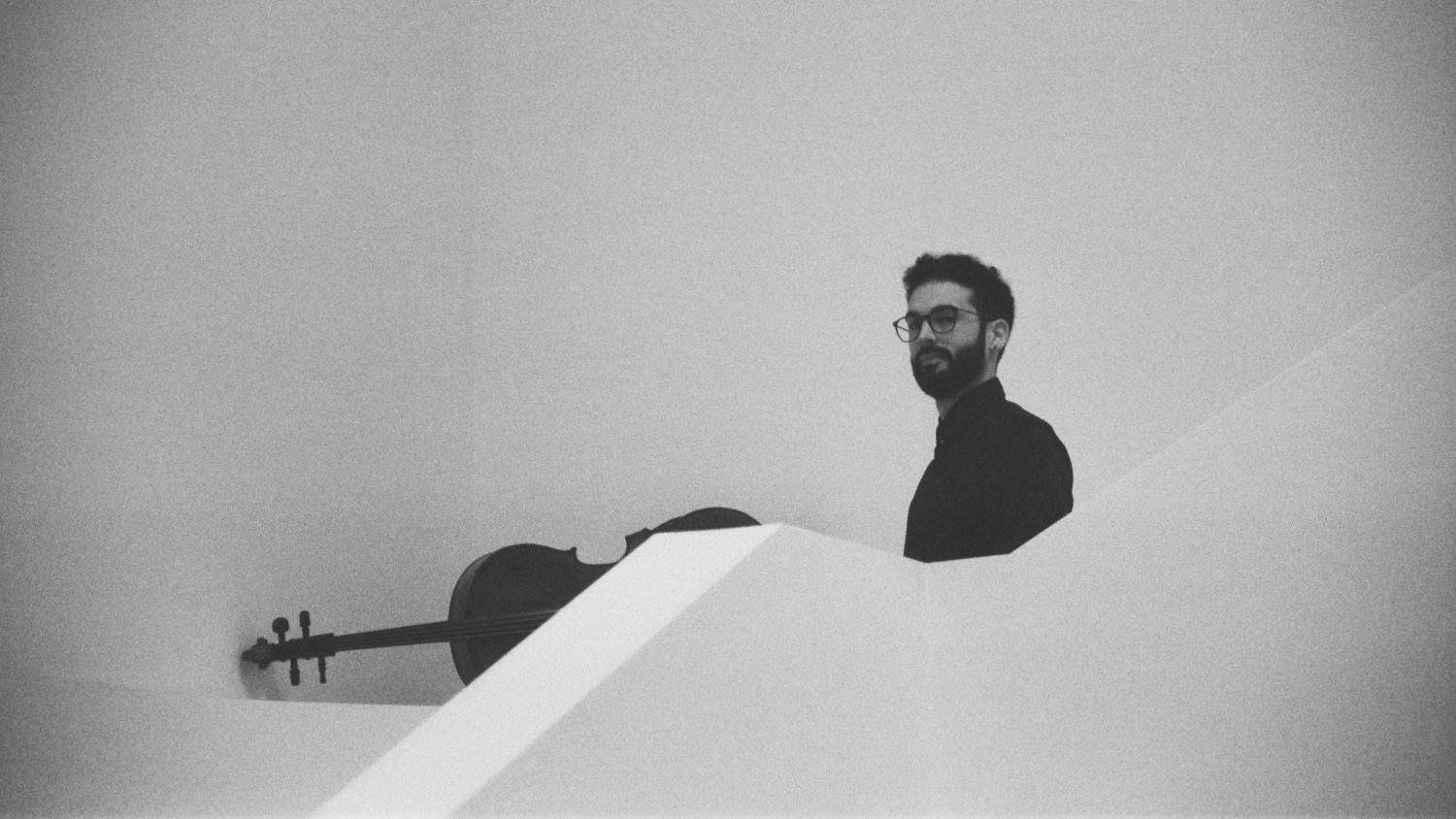
Stathis Giftakis, Indira Rahmatulla, Dimitrios Lampos | Photo Credit: Stylianos Papardelas
“After nine years, the festival is now firmly established. What is your vision for the future, and what legacy would you like it to leave for musicians and audiences?”
Dimitrios Lampos: Our shared wish is to revive the Kalamata Festival Orchestra —a chamber orchestra created by the festival and made up of musicians from Kalamata, Greece and across Europe. Due to lack of resources, the orchestra could not be included in last or this year’s programme. We hope that, now the festival has become one of the region’s leading music events, more stable state support will enable its return. We also dream of creating or finding a space in Kalamata to house the masterclass participants, who are currently scattered across the city. Such a space would greatly strengthen both musical collaboration and our wider artistic community.
For next year —the 10th anniversary— we envision a festival that will leave a meaningful cultural imprint on Greece’s music scene: artistically through dialogue and collaboration, and pedagogically through the masterclasses. That, ultimately, is the purpose of a festival. A festival should not be a fleeting spectacle —a brief firework— but an event that enriches and transforms a society while also keeping its gaze set firmly on the future.