

A journey filled with music and history in the capital of Messenia – Review on monopoli.gr (English translation)
By Aristoula Zachariou | First published on monopoli.gr
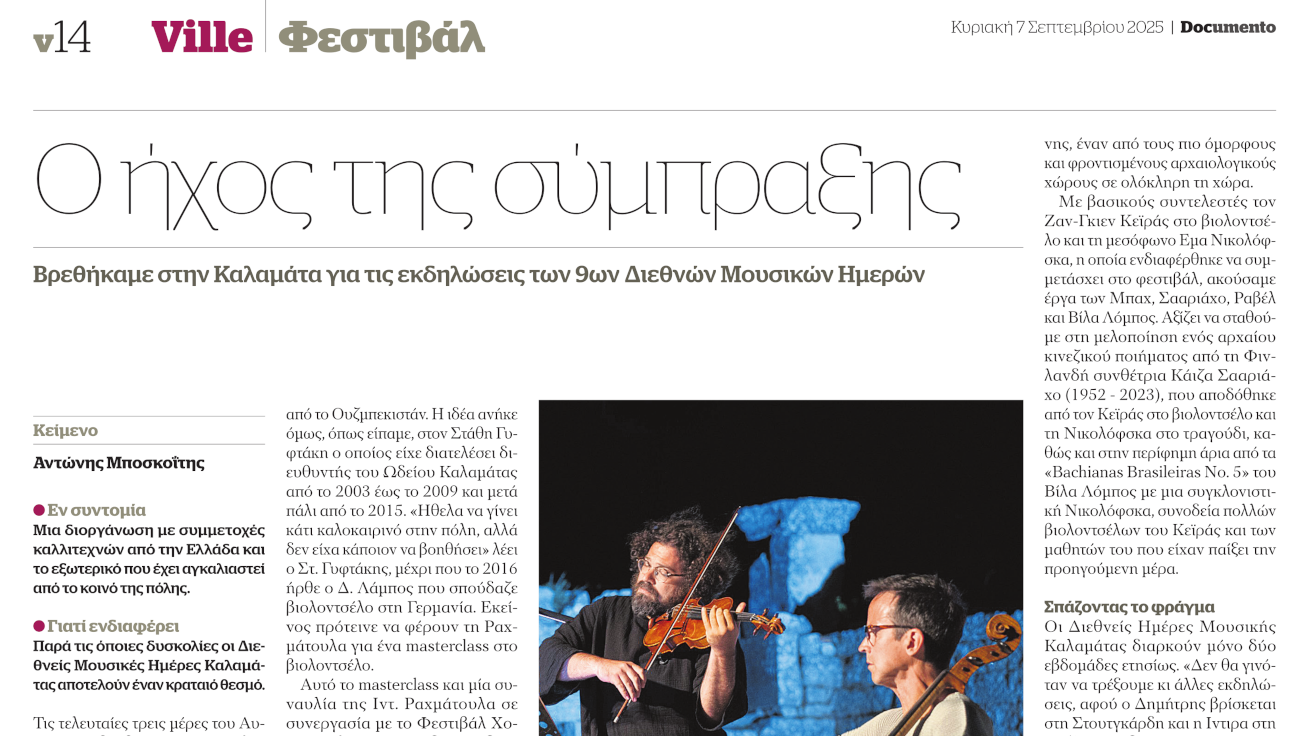
On the occasion of the International Kalamata Music Days, we travelled to the capital of Messenia and bring you our impressions of this major celebration of classical and jazz music, which —like the city itself— embraces the arts in a universal way.

© Credits: Vladan Raznatovic/ Unsplash
In Vasileos Georgiou II Square in Kalamata stands a visual artwork by Panagiotis Lambrinidis, created for the 200-year anniversary of the Greek Revolution: the Monument of Light. It consists of three parts. A vertical, metal cylindrical structure, perforated to allow light to pass through, on which is inscribed the first political and diplomatic text of the Greek Struggle, the “Proclamation to the European Courts” of the Messenian Senate. A horizontal marble slab with the word “freedom” written in every language of the world, its meaning “visualised” by the third, light-sculptural element: a beam of light that unites sky and earth. And one cannot help but think how perfectly such a powerful analogy fits when the word “music” crosses the mind.
For Kalamata —the first Greek city to be liberated— proudly displays and embraces art in exactly the same universal manner as it honours its history. It is, therefore, an excellent reason to visit and get to know the classical and jazz music festival International Kalamata Music Days, which this year takes place for the seventh time and concludes on 5 August. Its founding and organising team consists of Indira Rahmatulla, Stathis Giftakis and Dimitrios Lampos.
We had the opportunity to attend the first three days of its events, and we share our impressions of the festival as well as of our stay in the capital of Messenia.
First Day
Discovering the city
On the day of our arrival, we first acquainted ourselves with the city through an afternoon walk. In Kalamata, the modern and urban alternates with the traditional, offering visitors a variety of authentic images and experiences. It seems to live at its own relaxed pace, and this is one of the reasons —together, of course, with the warm hospitality and courtesy of its people— that makes one feel familiar with it almost instantly. And, most importantly, this city loves culture. It is an inseparable part of its unique and multifaceted character.

Piano Trio Isimsiz | Photo by Stylianos Papardelas
Piano Trio Isimsiz
That evening, we found ourselves at the Dance Megaron, an imposing modern architectural landmark, for the opening event of the International Kalamata Music Days. This year’s festival promised a programme filled with “contrast, freshness and dynamism”. And from its very first “welcome”, it became immediately clear that it would keep that promise.
For the opening, the organisers chose to present a musical ensemble visiting our country for the first time: Trio Isimsiz. Formed in 2009 at the Guildhall School of Music & Drama, it consists of Pablo Hernán Benedí (violin), Edvard Pogossian (cello) and Erdem Misirlioglu (piano). They introduced themselves through works by Joseph Haydn, Eric Wolfgang Korngold and Johannes Brahms, offering us an evening of profound musical interest.
Watching Trio Isimsiz, what impresses most is the way in which they externalise —through emphatic movements, expressive faces and generous interpretations— the manner in which they themselves “experience” the music within. Their enthusiasm is contagious, utterly natural and even somewhat playful. It draws you along wondrous musical “paths” which you discover, with a sense of surprise, to exist within your own soul, transforming an individual experience into a collective one.

The Kalamata Dance Megaron, an imposing cultural landmark of modern architecture | Photo by Aristoula Zachariou
Second Day
The historical centre
Kalamata is a city with a rich and fascinating history stretching deep into the centuries. It flourished during the Frankish rule and lived its most glorious moment with its liberation from the Ottoman yoke on 23 March 1821. From the late 19th century onward, it experienced significant development and prosperity, faced two devastating earthquakes, rebuilt itself and has remained to this day one of Greece’s most important urban centres.

The Byzantine Church of the Holy Apostles (11th–12th century) in the historical centre of Kalamata | Photo by Aristoula Zachariou
You have not truly come to know Kalamata unless you visit its historical centre, with its picturesque architecture, pedestrian streets, wide squares, shops, monuments and museums. There, we made four “must” stops.
We climbed to the Castle, which owes its present form to the reconstructions of the founder of the Principality of Achaea, Geoffrey I of Villehardouin (early 13th century), to enjoy the panoramic view reaching as far as the sea. We visited the Byzantine Church of the Holy Apostles (11th–12th century), where the revolutionaries Kolokotronis, Nikitaras, Petrobey Mavromichalis and Papaflessas attended the celebratory doxology after the city’s liberation. We toured the Archaeological Museum of Messenia, housed in the old enclosed Municipal Market, presenting the diachronic development of the city and wider region from the prehistoric period to Byzantine times (1453). And we left for last the Victoria G. Karelias Collection of Greek Costumes, one of the most comprehensive in the country, housed in the exhibition space of the Lyceum Club of Greek Women of Kalamata. Across three floors, complete costumes, jewellery, gold-embroidered outer garments, buckles and other accessories offered us an impressive “taste” of the dress traditions from all corners of Greece in the 19th and early 20th centuries, while at the entrance we admired the extraordinary detail with which Yiannis Metzikof’s drawings depict women’s traditional costumes of the Greek islands.

Ex Silentio in Ancient Messene | Photo by Stylianos Papardelas
Ex Silentio in Ancient Messene
Our “journey” through time continued in the evening with the concert by Ex Silentio at the theatre of Ancient Messene, to which we travelled by the festival shuttle bus. One of the many events of the International Kalamata Music Days with free admission for the public. Ancient Messene (founded 369 BC), an archaeological site about 35 kilometres from Kalamata, is an outstanding choice for a short excursion outside the city. The significant archaeological remains discovered there provide as complete an image as possible of an ancient city with its fortifications, theatre, agora and sanctuaries, stadium and gymnasium, Asklepieion, palaestra, funerary monuments and more. And, of course, its museum.
For such an evocative setting, we could think of nothing more fitting than Ex Silentio. This remarkable musical ensemble, under the artistic direction of Dimitris Kountouras, was formed in 2001 and specialises in early music and historically informed performance. On that Saturday evening, they offered us a magical experience under the starry sky, worthy of the reverence and mystagogy emanating from Ancient Messene. It was a night dedicated to Baroque music, with works by Vivaldi, Handel, Rameau and Rebel.
The distinctive sound produced by Ex Silentio’s period instruments —the historical flutes of Dimitris Kountouras, the Baroque violins of Fani Bovoni and Angie Kasda, the viola da gamba of Andreas Linos, the violone of Dimitris Tigas and the harpsichord of Panos Iliopoulos— and, of course, the mesmerising and moving interpretation of soprano Fani Antonelou, narrated musical “stories” about the birth of the world, the awe of existence, the four elements of nature, its incomparable beauty and other philosophical reflections that preoccupied the creators of that era.

The Theatre of Ancient Messena from above | Photo by Aristoula Zachariou
Third Day
The past and present of a city
The third and final day of our stay in Kalamata began with another visit to the historical centre, this time to see the Historical and Folklore Museum, housed in the traditional Kyriakou Mansion. There, we learned interesting information about the pre-industrial way of life of the people of Kalamata, with exhibits on daily life, agricultural and pastoral activities, textile craftsmanship, pottery, urban professions, printing and bookbinding. We saw how the bourgeois women of Kalamata adorned their homes. We wandered through rooms with historical material and artworks on the Greek Revolution, traditional costumes as well as the European influences that inspired local dress, and icons.
Then, leaving behind the city’s past, we decided to get to know its present. From the historical centre, we set off on a walk towards the port of Kalamata. The city is a delight to walk through. Wide pavements, pedestrian streets, large squares, parks, minimal traffic, numerous crossings and cycle lanes create ideal conditions for a relaxed stroll that lifts the spirits and can easily be combined with exploring the many gastronomic pleasures the city has to offer.

Cinema and music at the Railway Park | Photo by Stylianos Papardelas
Cinema and music in the Railway Park
In the evening, we found ourselves at the Municipal Railway Park of Kalamata, a 54-acre area that includes the Railway Museum, playgrounds, sports courts and open spaces for cultural events. Walking beside old OSE railway carriages and among the locals who fill the grounds in the late afternoon, we reached Eucalyptus Square to attend another free event of the International Kalamata Music Days.
There, silent cinema met music in a wonderful dialogue that brought many smiles to the audience. The Moving Band of the Municipal Conservatory of Kalamata (Giorgos Pavlakos, Stavros Tsotras, Ypapanti Alexandropoulou, Katerina Miliaresi, Stathis Giftakis) accompanied, with playful energy and familiar melodies, two hilarious Buster Keaton films, The Scarecrow (1920) and One Week (1920). Afterwards, Arion Gyftakis (double bass) and Tryfon Typou (piano) accompanied Albert Lamorisse’s The Red Balloon, a tender film about friendship, trust, the inexhaustible bounds of childhood imagination and childhood spontaneity, “transporting” us musically to the Paris of another era. The evening unfolded into a spontaneous celebration of music for the whole family, with enthusiastic applause and laughter.
What will I not forget from this three-day experience?
Naturally, the realisation that for the International Kalamata Music Days, music —and art more broadly— is for everyone and concerns everyone. Each one of us —emerging and established artists, audiences familiar and unfamiliar with classical and jazz music, and all those who worked to make the festival happen— has a place in this unique celebration. Through an exceptionally well-curated concert and educational programme —the International Kalamata Music Days also generously offers knowledge through masterclasses— everyone, regardless of language, place of origin or religion, is welcome to experience this collective spiritual encounter, to discover the secrets of music, to let it enter their hearts and speak a language that is at once universal and deeply individual.
Because music connects people from heart to heart with an invisible “thread”, just like the word “freedom” on Panagiotis Lambrinidis’s Monument of Light, which stands in a square in Kalamata. Because the International Kalamata Music Days is a festival that celebrates music, friendship and solidarity.